The Steinmetz lowering has been matched to the FlexRide System and the Watt linkage fitted to the rear axle. The Steinmetz lowering by 30 mm has been specially developed for city traffic, but is also ideal for a quick blast around the North Loop of the Nurburgring.
The Steinmetz Opel Astra body kit includes a new front spoiler, a totally black front grille and a roof spoiler. Other exterior styling accents offered by the Steinmetz Opel Astra program include designer strips and stainless steel door handle plates.
Both alloy wheels run on tires size 235/35/R19 without any adaptation to the wheelarches on the Astra J by Steinmetz.. For the interior, finished to a high standard by Opel, Steinmetz has developed a gear display which shows the driver – in his color of choice – the gear currently selected. Foot mats with a stainless steel logo, and sill trims of polished stainless steel, complete the Steinmetz product range for the Astra J.
The Steinmetz Opel Insignia Sports Tourer sports package includes a new front grille and spoiler that comply with pedestrian protection regulations, a roof spoiler and new tailpipe trims. The Insignia SportsTourer by Steinmetz sits on 20-inch alloy wheels with 245/35/R20 tires and features a lowering kit that takes the ride height down by 25 mm. The Steinmetz Opel Insignia Sports Tourer also comes with new tail pipes and a two-piece roof spoiler.
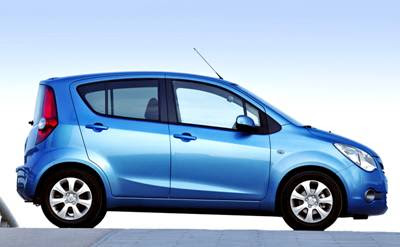
The Opel Agila is a minivan with five doors and five seats. It is smaller than the other two carriers of Opel, the Zafira and Meriva. This model shares many elements with the Suzuki Splash and replaces the previous Opel Agila.
Opel Agila
The Opel Agila is available with three engines, two petrol and one diesel and two levels of equipment called 'Essentia' and 'Enjoy'. The most affordable costs € 9520 (gasoline engine with 65 hp) and the most expensive € 12,920 (Diesel 75 hp).
Opel Agila
The Opel Agila is a practical car for use in day to day city is fairly large and has many holes throughout the interior to make objects. Maneuver in a small space (the turning diameter is 9.6 m) but the direction is not very directly.
Opel Agila
The Opel Agila is a car with good interior height, not very wide and with sufficient space for the legs of two adults of normal stature sitting one behind the other. Opel has placed the driver's seat at a rather high (in relation to tourism) to increase the driver's perspective.
Opel Agila
The driving position is correct but there are two areas for improvement: one is that the wheel does not adjust in depth and the other is that some drivers, the right leg will be resting on the edge of the center console, which is annoying over the miles.
Opel Agila
Since the width is small, the rear seats are only suitable for two adults or three children. The legroom in these places is not great and neither could be much higher but Opel has used a system of sliding rear seats lengthwise (like a Renault Twingo or a Toyota Yaris), as these are placed in a very delayed (This solution does a sliding rear seat that could have served to expand the capacity of the trunk when not in use the rear seats).
2008 Opel Agila Interior
Opel Agila
The maximum volume is 225 liter trunk and is less able than a Toyota Yaris or Nissan Micra, and more than a Peugeot 1007. Anyway there is a double bottom (35 liters capacity) in objects that fit the size of a backpack (for carrying a laptop) or the trunk tray. With the rear seats downcast, it measures 1050 l in volume. The folding rear seat can be partly because it is divided into two, with a 1 / 3-2 / 3.
2008 Opel Agila Engine
Opel Agila
The instrumentation consists of a large speedometer behind the wheel, with a screen and witnesses, and a separate counter and on a higher plane. The lighting is red, a detail that will also have future models. You may have controls on the steering wheel.
At least the version equipped with serial ('Essentia') there are four airbags, Isofix rings, steering assistance depending on the speed of the Opel Agila or the driver's seat with height adjustment, among other things. In version "Enjoy", more equipment, there are some elements.
You can have stability control but missing some elements of modern equipment (and more or less useful) as the entry system and keyless start, xenon headlights and automatic parking brake.
In the range of two petrol engines of origin Suzuki, a three-cylinder 1.0-liter displacement and 65 hp of maximum power, the other with four-cylinder, 1.2 liter 86 hp. There is also a 1.2-liter diesel engine capacity and 75 hp, which can carry particulate filter.
The gearbox is standard five-speed manual anyway. The more powerful petrol can also carry an optional automatic gearbox for four. The gear lever is close to the steering wheel which facilitates its use.
The most powerful gasoline engine has a CO2 emission of 140 g / km. The Opel Agila with less powerful engines (diesel and 75 petrol 65 hp) emission is 120 g / km, which are exempt from road tax. Purchased with other models of its size and power, the Opel Agila 86 hp petrol consumption is the best and the best acceleration.
Two petrol engines are aluminum, have indirect injection and four valves per cylinder with dual camshafts. Diesel, which makes GM Powertrain, is an iron block engine with four valves per cylinder, and feeding through common as the leading alternative models of Opel.
The chassis of the Opel Agila, such as the Suzuki Splash, is developed from having the Suzuki Swift. The front suspension is McPherson and the rear wheel axle torsional coupled runs. The smaller wheels will be 15 inches.
The stability control can not disconnect, but the traction control: it facilitates the circulation in conditions of low grip, such as on roads where snow chains are carried on.
The Opel Agila measures 3.74 m in length, almost the same as a Peugeot 1007 (3.73 m). The Opel Agila is much larger than the previous (3.53 m). The width is 1.68 m and height 1.59 m. Proportions are normal among carriers of this size. The previous Opel Agila was higher than wide (1.62 wide and 1.69 high). The aerodynamic coefficient is 0.35, a mean value.
Until now, smaller carriers are not having success. Sales of the Mitsubishi Colt, Peugeot 1007 and Renault Modus are lower than anticipated; Toyota has not released in Europe a version of the current Yaris Verso.
A model of this type, which has been more acceptances, is the Opel Meriva, which is distinguished from them by having a larger size and a wider range of engines.
With five doors and five seats, the new Opel Agila is not only as practical as its predecessor, which sold over 440,000 units, but is now also much more dynamically designed. The small, versatile Opel was unveiled to the public at the 2007 IAA in Frankfurt (September 13 - 23, 2007) and made its market premiere in spring 2008. It boasts balanced proportions, soft curves and a distinctive side graphic. Its passengers still sit high and upright, but the roofline has been dynamically lowered and now blends into a smooth arc toward the rear. This helps create the Opel Agila's aerodynamic drag coefficient of 0.35 - a relatively low figure for a vehicle of this size. The urban car is now 20 centimeters longer, six centimeters wider, but seven centimeters lower than its predecessor.
The front boasts typical Opel styling. With its round headlamps integrated into almond-shaped lamp units that echo the new Corsa, the Opel Agila sees the world through wide eyes. The tapering of the front and rear bumpers are also typical Opel elements, just like the crease in the hood.
The same is true for the interior: the boring days are over. A wide selection of fresh colors and modern styles create an ambience that's enhanced even more by the spacious headroom. The versatile five-seater's high seating position ensures good visibility, while the high placed gear stick and height-adjustable steering wheel with radio remote controls ensure easy operation. The rev counter is housed separately on the instrument panel.
But it's not just car essentials that the new Opel Agila stows away easily. Despite its compact exterior dimensions, the new Opel urban car boasts a surprisingly large luggage compartment. Its standard capacity up to the luggage compartment cover is 225 liters, large enough for a strollere. One turn of a handle drops the rear bench seat back, increasing the load volume to an impressive 1050 liters - a top value in this segment. The rear bench seat and back also splits 60:40 for even greater versatility.
All Opel Agila models have a wide range of standard equipment, including safety features such as ABS, front and side airbags for driver and front passenger, front passenger airbag deactivation and mountings for the ISOFIX child seat system.
Two gasoline engines make their world premiere in the new Opel Agila. Supplied by cooperation partner Suzuki, they share the same design - aluminum cylinder block and head, as well as two overhead camshafts.
The entry-level unit is the almost one-liter, three-cylinder gasoline engine. The four-valve unit produces 65 hp (48 kW) and has a top speed of 160 km/h. The 1.2-liter four-cylinder gasoline engine produces 86 hp (63 kW), accelerates from zero to 100 km/h in less than 12 seconds and has a top speed of 174 km/h (values for five-speed manual version).
The fuel-saving master among the Opel Agila engines is the 1.3-liter common-rail turbo-diesel. Developed by GM Powertrain, the diesel engine is a true multi-talent and also offers an especially efficient alternative in the Corsa and Astra model lines. In the new Opel Agila it produces 75 hp (55 kW), has a top speed of 162 km/h and a zero to 100 km/h sprint of 13.5 seconds. The powerful diesel unit with a maximum torque of 190 Nm is very economical: on average it consumes less than five liters per 100 km, which represents a CO2 per kilometer value of under 130 g (finalized values not yet available).
Make the Opel Agila even more agile - that was the aim during chassis development. The new dynamic look is also reflected in the car's responsiveness. The Opel Agila's chassis, which features A-arms and McPherson struts in front and a torsion beam axle in the rear, is tuned for driving fun. Depending on the market and equipment variant, the Opel Agila also features an Electronic Stability Program (ESP).
The four-seat coupé is powered by a 220 kW/300 hp, 2.8-liter V6 turbo gasoline engine and features an intelligent, electronically-controlled four-wheel drive system, which provides optimum traction and stability as well as excellent agility in all driving conditions. Brand-typical on-board flexibility is ensured by the thoughtful "Flex4" system (patent application submitted). The backs of both rear seats can be docked separately to the front seats by remote control, creating a spacious three or two-seater with flat load floor and up to 1020 liters of luggage compartment capacity. As is typical of Opel cars, the seats do not have to be removed or installed.
Dynamic design: Visually communicating the Opel brand promise The GTC Concept reveals the next-generation of Opel styling. Much like the Opel Speedster did in 1999, or the GTC Genève Concept did in 2003 this car marks a break in the evolution of Opel's design language and signals that the next chapter is about to be written.
Key elements of the silk grey-lacquered Coupé concept car finished with a matte grey paint (length/width/height: 4830/1867/1432 millimeters, wheelbase: 2737 mm) begin with an aggressive front end performance face emphasized by large aluminum vertical intakes that intersect the headlamps. These vertical elements are mimicked in the rear exhaust elements, proposing an unmistakable down-the-road signature performance graphic, coming or going.
The proud front is highlighted by a prominent, trapezoidal grille with signature Opel bar and Blitz, executed in polished aluminum, and gracefully finished with a bolder Opel Blitz emblem concept. The centerline crease coupled with the distinctive aluminum vertical intakes and outboard LED vertical driving lamps choreograph in harmony to visually communicate power and strength. The distinctive design continues with LED technology, enabling creative headlamp inner shapes that propose a night time signature illumination graphic in the front and rear lamps.
In addition, large flares hug the aggressive wheel and tire package, visually suggesting road confidence to the customer. Thanks to the wide track (front/rear: 1627/1629 mm), the Opel GTC Concept provides a commanding stance, planted by 20-inch rims with 245/40 R20 "red line" styled rubber. The wheels reference the motor sport aesthetic of black rims - however, elegantly finished with high- gloss black spokes contrasted with machine polished edges, alluding a signature performance wheel look.
The GTC Concept's rear visual solutions strategically echo the design language of the nose with an integrated rear bar and blitz emblem resting on the distinctive Opel rear center crease. Sophisticated surface development sculpturally integrates the rear spoiler into the sheetmetal to visually communicate performance. The rear appearance features Opel signature shaped rear lamps, uniquely displaying a LED night lighting graphic showcasing the exterior brand identity. The smart exterior shape and aerodynamic characteristics are rewarded by the cD value of 0.25.
The Interior design: Warmer and more inviting Opel's interior designs have progressed to become warmer and more inviting in products like the new Corsa, Antara and Opel GT. However, the Opel GTC Concept significantly represents the next chapter of Opel's interior brand identity. Echoing the exterior, the interior shapes and surfaces are sculpturally-crafted to visually articulate a dynamic driving experience. The dashboard's top-pad wraps around from the instrument panel to the door, embracing the occupants. The sweeping décor dynamically stretches one's eye from the surfaces of the door and instrument panel, creating a memorable environment. The horizontal theme is secured with a large integrated centerstack design floating above the décor surface, an appearance reminiscent of premium audio equipment.
Complementing the exterior material theme, matte ebony surfaces are contrasted with rich high-gloss piano black décor finishes and structurally elegant aluminum accents, revealing a new standard of Opel aesthetics. The U-shaped aluminum graphic on the steering wheel is reflected again on the center console and the gear shifter, visually connecting the driving interfaces to emphasize Opel's driving dynamics. The rotating navigation control is ergonomically positioned, allowing it to easily be located and controlled by the driver, without having to remove his/her eyes from the road. The four, sporty, round instruments encircled by translucent rings are backlit in dynamic red, replacing Opel's traditional amber tones. These interior appearance solutions intentionally reinforce the dynamic ownership experience Opel provides. As a final identity concept, the refined "redline" graphic of the tire pattern is vertically woven into the contoured sport seat surfaces and the centerline of the steering wheel, proposing that a visual performance identity can be distinctive without compromising taste.
Intelligent packaging: Compact exterior with spacious, flexible interior With the lower seating position and vertical hip point ? known as the H-point? , both front occupants sit perfectly integrated in the car. Thanks to the lower-set instrument panel, outward visibility remains excellent. This also provides a generous sense of space, an effect strengthened by its color: the instrument panel's upper section is dark, while the lower section is light.
The intelligent packaging is further highlighted by plenty of space in the rear of the Opel Concept car, despite its flat roof line: rear headroom is 920 millimeters. The rear seats are set low, but the four-seat, two-door car still offers Opel's brand-typical flexibility thanks to a novelty developed by Opel engineers: the "Flex4" interior concept (patent application submitted). "Flex4" enables the backs of both the rear seats in the Coupé concept car to be moved forward separately at the touch of a button via sensor-control and docked to the front seats. The luggage compartment cover is thereby automatically pulled over the remaining seat surfaces in the floor. This creates a three or two-seater with a flat load floor up to 1.80 meters long. Luggage compartment capacity increases from 500 liters to 755 liters (three-seater) or up to 1020 liters (maximum capacity: up to waistline).
Powerful engine and intelligent four-wheel drive system The Opel GTC concept car is powered by a turbocharged, 220 kW/300 hp, 2.8-liter V6 gasoline engine with two variable camshafts, which is combined with a six-speed manual transmission. Maximum torque of 400 Nm is available from 1850 up to 4500 rpm, and accelerating from zero to 100 km/h is calculated to take around six seconds. Top speed is limited to 250 km/h. The power from the high-tech turbo engine is channeled via an advanced, electronically-controlled four-wheel drive system, which is fully integrated into the car's adaptive IDSPlus chassis management system. An electronically-regulated torque transfer device seamlessly distributes power between the front and rear axles for optimum traction and driving performance. The high-speed control allows more power to be provided to the rear axle before any traction loss can occur, for example during quick acceleration. This creates a driving feel similar to a sporty rear-wheel drive car. An electronically-controlled limited slip differential at the rear axle provides additional stability and traction thanks to torque distribution between the rear wheels.
Major benefits of the Opel GTC Concept's intelligent four-wheel drive system are: optimum traction and stability in all driving conditions as well as excellent agility and an active driving feel.


 The Steinmetz lowering has been matched to the FlexRide System and the Watt linkage fitted to the rear axle. The Steinmetz lowering by 30 mm has been specially developed for city traffic, but is also ideal for a quick blast around the North Loop of the Nurburgring.
 The Steinmetz Opel Astra body kit includes a new front spoiler, a totally black front grille and a roof spoiler. Other exterior styling accents offered by the Steinmetz Opel Astra program include designer strips and stainless steel door handle plates.
 Both alloy wheels run on tires size 235/35/R19 without any adaptation to the wheelarches on the Astra J by Steinmetz.. For the interior, finished to a high standard by Opel, Steinmetz has developed a gear display which shows the driver – in his color of choice – the gear currently selected. Foot mats with a stainless steel logo, and sill trims of polished stainless steel, complete the Steinmetz product range for the Astra J.